Not medical advice. This article is general information from a strength coach, not a diagnosis or a treatment plan. If something hurts, see a physiotherapist or doctor first, and follow their advice over anything you read here.
A while back I took a break from basketball. When I came back, the only court I could get was outdoors, on concrete. I had done less conditioning than usual. Within a couple of weeks my knee was barking every time I landed.
I'm a coach. I knew better. I did it anyway, because I love the game and I wanted to play.
Here is the part that matters. I did not stop playing. Basketball was not the problem. The problem was the maths.
Your body keeps an account
I think about the body like a bank account.
A deposit is anything that makes your body able to handle more: getting stronger, landing better, moving a joint through more of its range with control.
A withdrawal is anything that takes from that: the same motion repeated hundreds of times, a hard landing, a long match on a tired body.
An example month. The balance starts at plus 10. Each gym session adds 3. Each tennis match takes 2, and a long match takes 5. After two long matches the balance is minus 4: overdrawn.
Withdrawals are not bad. Every game you love is paid for with them. That is what the account is for.
The trouble starts when you spend more than you put in, for a long time. Stay overdrawn and the body sends you a bill. A sore elbow. A swollen knee. A back that locks up on Monday morning.
Your sport isn't the deposit
This is what most people miss. Your sport is good for your heart. On your body, it's mostly a withdrawal.
Take tennis. An hour on court is great for your heart, your legs and your footwork. On your body, it is a withdrawal: your hitting shoulder, your elbow, your knees and your lower back. One arm does all the swinging. You turn the same way a few hundred times.
Running is the same story. It is a huge deposit for your heart. For your body, it is the same step, thousands of times, each one landing on a single leg.
Pickleball got a lot of people moving again, and I love that. It also asks for sudden starts and stops from calves that have not sprinted in years.
So when someone tells me "I play three times a week, I'm fit", they are right. And they can still be overdrawn. Both things are true.
The ledger for 20 things people do to stay healthy
Here is how I see the most popular ones. Your own ledger depends on your body and your history, so treat this as a starting point.
Pick yours.
The four at the bottom
Walking, swimming, yoga and Pilates take very little out. That is their strength.
It is also the catch. They keep the balance where it is. They do not grow it much. Walking will not train you to catch a stumble. A swim will not load your bones. Yoga gives you range, but not always the strength to own that range.
I'm not telling anyone to stop. I'm saying the deposit is smaller than it feels. If one of these is all you do, add something heavy twice a week.
Dave's October
Dave is one of our students. He loves tennis. He came to us in October and wrote one line on his intake form:
"I want to improve my stability, lose some weight and play sports again pain free."
That last part is what an overdrawn account sounds like: a sport he loves, taking out more than was going back in.
So we did not take tennis away. We started making deposits. Here is his real October.
+99
Coached sessions, none missed
Above the line: in the gymOctober 2026, minutes a dayBelow the line: tennis
- 9 coached sessions between 6 and 29 October. None missed, even with a trip to Melbourne in the middle.
- 9.5 hours of deposits in the gym.
- 3 tennis matches: 3.5 hours on court.
- His push-ups went from hands on a raised bar on 13 October to push-ups from the floor on 29 October.
- His hinge went from a 20-second hold against a wall to holds of 30 seconds on one leg with support. A hinge is bending from the hips with a flat back, the way you should pick something up.
- Jumping came back. He started holding rings for support and finished the month doing squat jumps with a band.
And one honest line on the other side of the book. On 23 October he played a 90-minute match. In his words he "probably overdid it a bit". The next morning his knee was swollen.
That is what a withdrawal that is too big looks like. A month earlier it might have ended his tennis for weeks. This time he came in the next day and we squatted only as deep as he could go without pain. He trained again three days later. By the end of the month his sessions felt like an 8 out of 10 for effort, up from a 4.
One month does not fill an account. But the direction changed.
What a real deposit looks like
Three rules I use.
1. Put it in where your sport takes it out. A runner needs strong calves and strong single-leg landings. A tennis player needs both sides of the body trained, not just the hitting side. A climber needs to push, because the sport is all pull.
2. It has to be hard enough to count. A deposit is moving against something that pushes back. If it never gets heavier or harder, the body has no reason to change.
3. When you're overdrawn, you have two moves. Spend less for a while, put more in, or both. With my knee I kept playing and put more in: single-leg strength, landing drills, holds for the pain and one or two extra conditioning sessions a week so my legs still worked when I was tired. It was gone in four to six weeks.
The maths changes as you get older
At 25 a hard match costs you pennies and a gym session pays you dollars. At 50 it starts to flip. The withdrawals get bigger and the deposits get smaller. Later on, pennies become hundred-dollar bills.
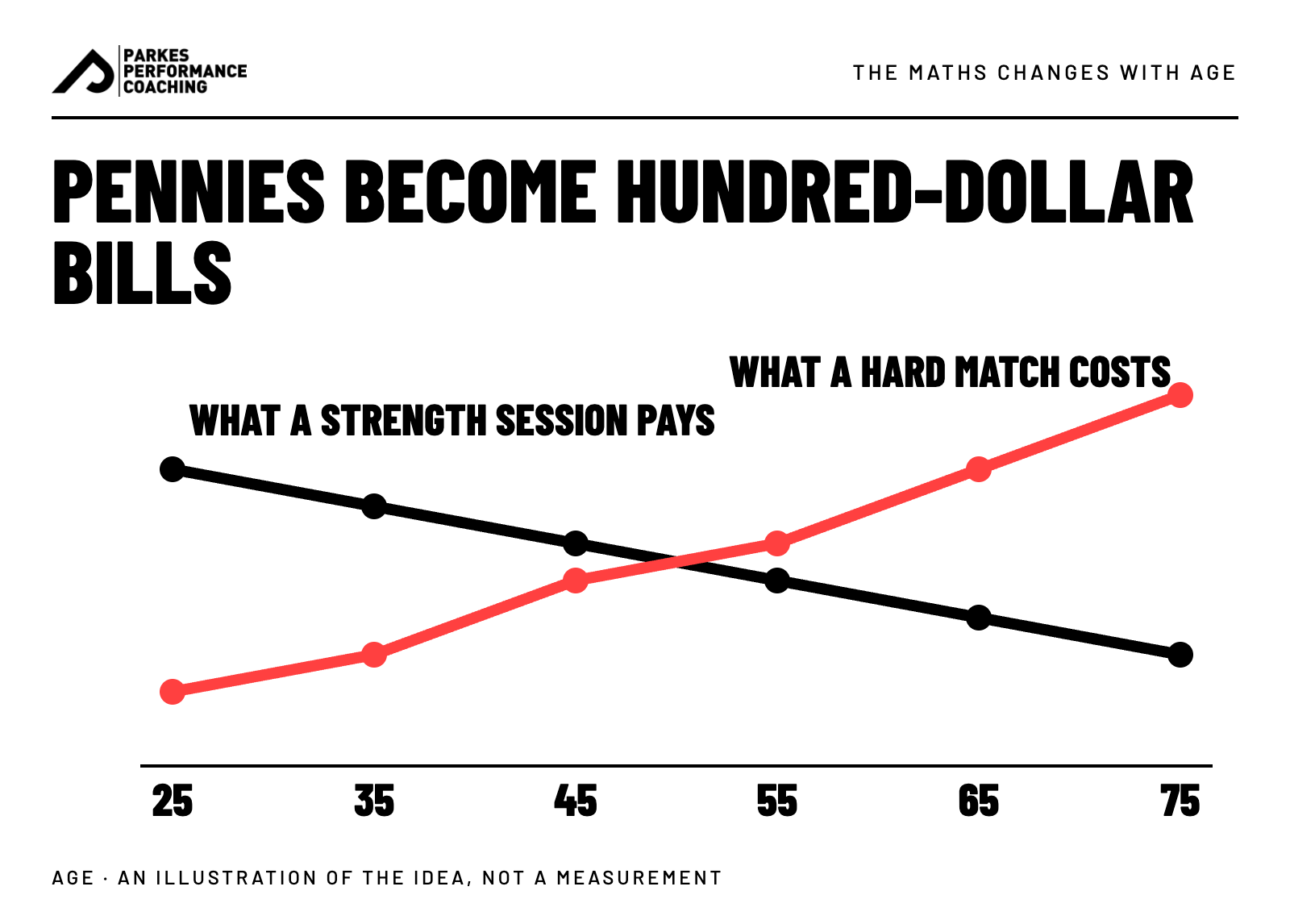
That is not a reason to stop. It is the reason to start depositing now, while the deposits are still big.
You don't have to quit
Nobody needs to give up the game they love. I would never ask that.
The goal was never to be the best on the court. It's to still have a ticket to play. You're either in the arena, or you're watching.
So look at your own book. What is your sport putting in? What is it taking out? And what have you put back this month?
If you don't know, that is what our Audit is for. It shows you where your account stands.
Take the Audit